Help! I don't know what memes are!
Well, you're in good company!
There's a lot of uncertainty surrounding what defines a "meme," especially as the term becomes more widespread. Thus, it is important to delineate exactly what a "meme" is.
A meme in the sociological sense is a piece of information that spreads within a culture. Similarly, internet memes spread through websites and subcultures. Internet memes are almost unilaterally humorous in nature, and often serve as collective in-jokes that define a user's allegiance to a specific group.
For example, someone may use the phrase "I accidentally ___" to convey that he was an active member of 4chan's image boards in 2008, the time during which the accidentally ___ meme became popular. The phrase is opaque to those unfamiliar with the format, so expressing comfort with the meme indicates membership in what is this case a less-than-elite fraternity.
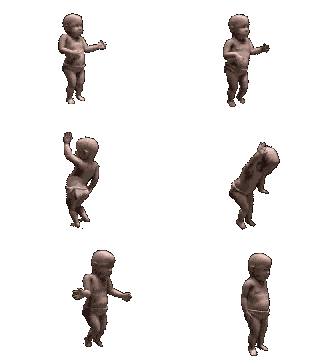
A critical aspect of a proper internet meme is that it is altered and capable of evolution as it spreads. Accidentally ___ may be applied in a large variety of situations while retaining the same fundamental format. Conversely, the dancingbaby.gif did not meaningfully change as it spread across the young Internet, so while it was "viral" it was not a full-fledged "internet meme."
With this in mind, we may settle upon a consistent definition separating the memes from the boys:
An internet meme is:
An audio, video, textual, or pictoral framework that may be modified to create works that are reminiscent and derivative of an original example but not limited, in scope or in content, to said ur-instance.